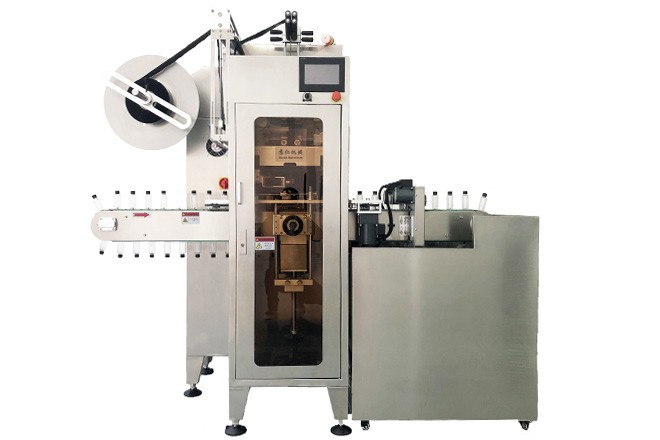
Small bottles are widely used in industries such as cosmetics, pharmaceuticals, beverages, essential oils, and personal care products. Their compact dimensions create specific challenges for labeling, including accurate sleeve positioning, controlled film application, and consistent shrinking. A small bottle sleeve labeling machine provides an automated solution for applying shrink sleeve labels to compact containers while supporting different packaging designs and production requirements.
As manufacturers develop more portable products and smaller packaging formats, reliable labeling equipment has become an important part of modern production lines.
Addressing the Challenges of Small Bottle Labeling
Compared with standard containers, small bottles have limited surface areas and shorter labeling sections. Even minor positioning errors can become noticeable on a compact package.
The machine must control bottle transportation and sleeve placement carefully to ensure that labels are applied at the intended height. Suitable guiding and positioning mechanisms help maintain container stability throughout the labeling process.
Manufacturers should evaluate bottle dimensions and structural features before selecting equipment to ensure that the machine is suitable for their specific packaging requirements.
Maintaining Label Accuracy on Compact Containers
Small bottles often have narrow bodies, short necks, or curved shoulders. These features can affect sleeve positioning and the final appearance of the label.
The sleeve length, cutting position, and feeding settings should be adjusted according to the bottle design. Accurate coordination between these elements helps prevent labels from covering unintended areas or extending beyond the desired position.
For products with detailed printed graphics, consistent label placement is especially important because small deviations can affect the overall visual presentation.
Controlling the Shrink Process
After sleeve application, the bottles typically pass through a shrink tunnel to achieve the final packaging shape.
Small containers require appropriate heating conditions because their dimensions and material characteristics may differ from those of larger bottles. Excessive heat may affect certain plastic containers, while insufficient heating can result in loose film or visible wrinkles.
Temperature distribution, conveyor speed, and heating time should be adjusted according to the selected film and bottle material. Testing sample containers helps establish suitable operating parameters before regular production.
Applications Across Small-Format Packaging Industries
Small bottle sleeve labeling machine can serve manufacturers producing a wide range of compact containers.
Cosmetics: Travel-size lotions, serums, and skincare products.
Pharmaceuticals: Selected liquid medicine bottles and healthcare containers.
Essential oils: Small bottles used for concentrated oils and related products.
Beverages: Miniature drink bottles and sample-size packaging.
Personal care: Compact shampoo, conditioner, and hygiene products.
Different applications may require different sleeve materials, label coverage, and production configurations. The machine should be selected according to the actual container and packaging specifications.
Supporting Flexible Packaging Designs
Small-format products often use distinctive packaging to communicate product information within a limited space. Shrink sleeve labels can provide extensive surface coverage, making room for branding, instructions, ingredients, and other printed details.
Manufacturers can choose full-body or partial sleeve designs depending on the intended appearance. Different printed designs can also be developed for product variations, promotional packaging, or new product launches.
The relationship between the artwork, film dimensions, and bottle geometry should be considered before mass production to ensure that important information remains visible after shrinking.
What to Consider When Choosing a Machine
Selecting suitable equipment requires more than checking its maximum production speed. Manufacturers should review the following factors:
1. Minimum and maximum bottle dimensions.
2. Bottle material and structural characteristics.
3. Sleeve film type, width, and thickness.
4. Required labeling position and coverage.
5. Expected production capacity.
6. Shrink tunnel configuration and heating requirements.
7. Compatibility with existing packaging equipment.
Providing actual bottle samples and film specifications can help equipment suppliers evaluate the application and recommend an appropriate machine configuration.
Contact: Wendy
Phone: +86-13482266656
E-mail: wendy.jiang@sr-packing.com
Add: No. 18, Changting Road, Fengxian District, Shanghai, China


 Español
 русский
 Português
 Deutsch
 Français
 Italiano
 Nederlands
 Polski