In the world of modern packaging, shrink sleeve labeling offers unmatched visual impact and functional versatility. However, even the most advanced production lines can encounter aesthetic defects most notably wrinkling and bubbling that compromise product presentation and brand integrity. These issues are rarely the result of a single factor; rather, they stem from subtle imbalances across material, machine, and environmental variables.
1. Inconsistent Film Quality or Mismatched Material Properties
Shrink films such as PVC, PETG, and OPS each have unique shrinkage ratios, elasticity, and thermal response curves. Using film with uneven thickness, poor lay flat characteristics, or inconsistent additive dispersion can lead to localized over shrinking or resistance to contraction. Even minor batch to batch variations in film formulation may manifest as wrinkles or trapped air pockets during heating.
2. Improper Heat Profile in the Shrink Tunnel
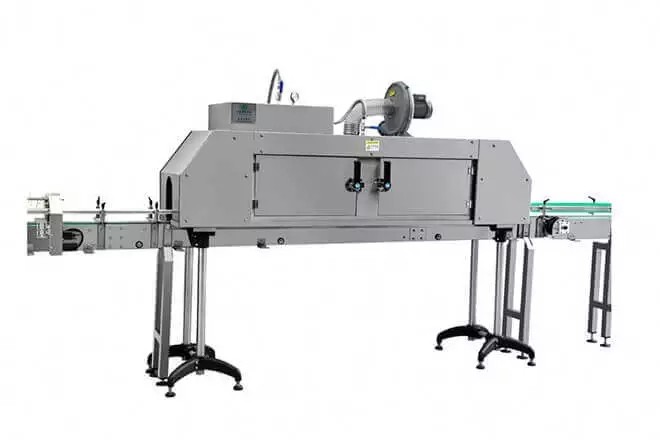
The core of the problem often lies in the heat shrink tunnel machine’s thermal dynamics. If heat distribution is uneven whether due to misaligned nozzles, clogged airflow channels, or inadequate zone calibration certain areas of the label receive too much or too little energy. Overheating causes rapid, uncontrolled shrinkage that pulls the film into folds, while underheated zones fail to fully conform to container contours, leaving bubbles or loose panels.
3. Incorrect Label Length or Pre Stretch Settings
A label cut slightly too long for the container circumference will inevitably buckle during shrinking. Similarly, insufficient pre stretching on oval or contoured containers prevents the film from smoothly adapting to complex geometries. The result is compression stress that releases as wrinkles along vertical seams or horizontal bands.
4. Trapped Air and Poor Ventilation
As the film shrinks around the container, air must escape efficiently. Labels applied without adequate perforation or tunnels lacking proper exhaust airflow trap air between the film and the bottle surface. This trapped air expands when heated, forming visible bubbles that may not collapse even after cooling.
5. Container Surface Conditions and Conveyance Issues
Moisture, dust, or residual lubricants on containers can create micro barriers that inhibit intimate film contact before shrinking begins. Additionally, if bottles wobble or shift during transit through the tunnel, the label may skew, leading to asymmetric shrinkage and distortion.
6. Cooling Phase Neglect
Shrinking doesn’t end when the label exits the heat zone. Rapid, uniform cooling is essential to “set” the film in its final form. Inadequate cooling can allow residual heat to continue deforming the label, especially on dark colored containers that retain thermal energy longer.
Addressing these defects requires a holistic approach: validating film compatibility, fine tuning tunnel parameters for specific container profiles, ensuring clean and stable conveyance, and implementing real time monitoring of temperature and airflow. As brands push for thinner, more sustainable films and faster line speeds, mastering these variables becomes not just a quality imperative but a competitive necessity.
Contact: Wendy
Phone: +86-13482266656
E-mail: wendy.jiang@sr-packing.com
Add: No. 18, Changting Road, Fengxian District, Shanghai, China


 Español
 русский
 Português
 Deutsch
 Français
 Italiano
 Nederlands
 Polski