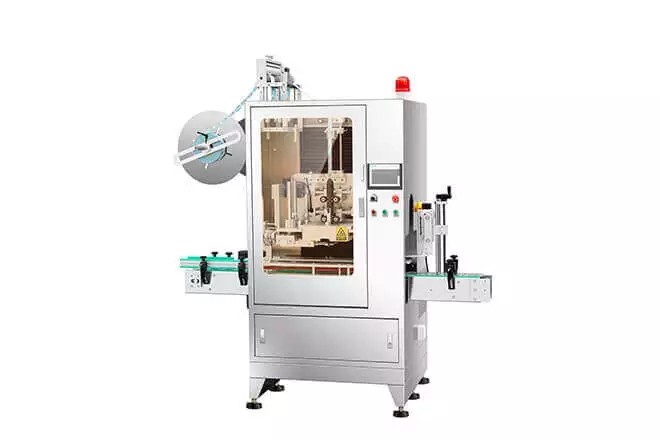
For decades, the packaging industry was largely confined by the geometric limitations of traditional labeling. Standard adhesive labels simply could not conform to complex curves, ergonomic grips, or asymmetrical bottle designs. Today, the modern sleeve labeling system has shattered these constraints, offering brand owners and packaging engineers unprecedented design freedom. By moving beyond standard cylinders, this technology empowers brands to create packaging that is as structurally innovative as it is visually striking.
Embracing Ergonomic and Asymmetrical Container Shapes
The most profound impact of a sleeve labeling system is its mechanical ability to accommodate non-traditional container architectures. Modern consumers are increasingly drawn to packaging that offers a superior tactile experience. Brands are responding with contoured bottles, hourglass silhouettes, and custom-molded grips. Because shrink sleeves are applied loosely and then heated to conform perfectly to the container's exact topography, they effortlessly wrap around complex 3D shapes. This allows designers to prioritize ergonomics and unique structural aesthetics without the fear of wrinkled labels or exposed, unlabeled gaps.
Uninterrupted Canvas for Premium Brand Storytelling
Design freedom also translates to uninterrupted visual communication. Traditional labels require margins, seams, and overlaps that break the visual flow. A sleeve labeling system provides a seamless, edge-to-edge canvas that wraps flawlessly around any vessel. This continuous surface enables designers to utilize panoramic imagery, wrap-around patterns, and bold color-blocking that creates a striking 360-degree visual impact. Whether showcasing the rich texture of a premium spirit or the vibrant botanicals of a skincare serum, the packaging itself becomes a cohesive piece of brand art.
Accelerating Prototyping and Creative Iteration
In the highly competitive consumer goods market, speed to market is a critical advantage. Traditional packaging methods often require expensive, time-consuming tooling for custom containers and specialized label dies. Sleeve labeling systems dramatically lower the barrier to entry for innovative packaging. Because the label adapts to the container rather than requiring a custom die-cut, brands can rapidly prototype new designs and test unconventional shapes in the market. This agility allows companies to iterate their packaging designs based on consumer feedback without massive capital investments, fostering a culture of continuous creative evolution.
Harmonizing Form, Function, and Sustainability
Maximizing design freedom does not mean compromising on functionality or environmental responsibility. The versatility of modern sleeve systems allows for the integration of functional design elements directly into the packaging. Designers can incorporate tactile varnishes, soft-touch finishes, or embossed textures onto the sleeve to enhance the unboxing experience. Furthermore, as the industry pushes for sustainable design, these systems are increasingly compatible with recyclable mono-material films and easy-tear perforations. This ensures that the pursuit of bold, boundary-pushing design remains aligned with modern eco-conscious standards, proving that aesthetic innovation and sustainability can seamlessly coexist.
Contact: Wendy
Phone: +86-13482266656
E-mail: wendy.jiang@sr-packing.com
Add: No. 18, Changting Road, Fengxian District, Shanghai, China

 Español
 русский
 Português
 Deutsch
 Français
 Italiano
 Nederlands
 Polski