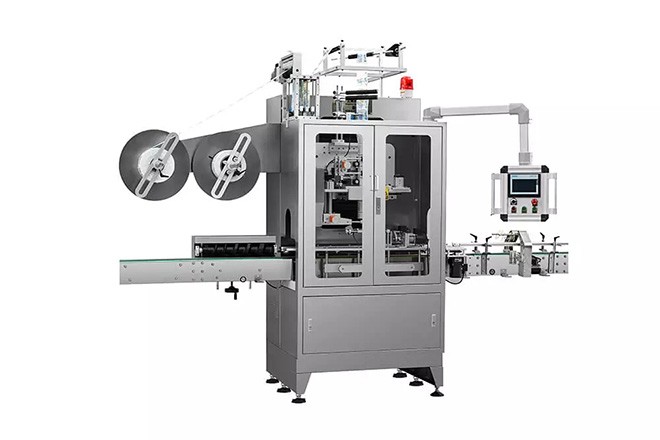
In modern packaging automation, production efficiency depends on the synchronization of every machine within the line. Filling systems, conveying units, labeling equipment, and inspection devices are designed to operate in a balanced flow. However, when one component fails to keep pace with overall production demand, system imbalance occurs. One common example is when the sleeve applicator cannot match the required line speed.
This mismatch may seem like a small technical limitation, but in continuous manufacturing environments, it can significantly affect productivity, stability, and product consistency.
Production Imbalance in High-Speed Packaging Lines
When packaging lines are designed for high output, each machine is expected to operate at a compatible speed level. If the sleeve applicator operates slower than upstream equipment, products begin to accumulate before the labeling stage.
This accumulation forces the entire system to adjust its operating speed downward, reducing overall line efficiency. In severe cases, intermittent stopping may occur, disrupting the continuous flow of production.
Impact on Overall Throughput
Line throughput is determined by the slowest component in the system. When sleeve applicator speed becomes the limiting factor, the entire production output is affected.
Even if filling and conveying systems are capable of higher performance, they cannot operate at full capacity without causing congestion. This results in underutilization of equipment and reduced production efficiency across the entire line.
Increased Pressure on Upstream Equipment
A speed mismatch does not only affect the applicator section, it also impacts upstream processes. Filling and transport systems may experience frequent start-stop cycles as they attempt to synchronize with slower downstream labeling operations.
These repeated adjustments can increase mechanical stress and reduce operational smoothness, leading to inefficiencies that extend beyond the labeling stage.
Labeling Accuracy Under Speed Constraints
When sleeve applicators are pushed beyond their optimal operating range, labeling accuracy may also be affected. Higher demand speeds can introduce instability in sleeve positioning or timing control.
This can result in inconsistent label placement, which may require additional inspection or correction. In high-quality production environments, even minor deviations in label alignment can impact product presentation standards.
Material Handling Challenges at Higher Demand
Sleeve materials require controlled handling during feeding and placement. When line demand exceeds applicator capacity, material flow may become less stable.
Irregular feeding can lead to sleeve shifting or uneven positioning before the shrinking process. This increases the likelihood of defects and reduces overall packaging consistency.
Synchronization Issues with Downstream Systems
After sleeve application, products typically pass through shrink tunnel systems for final label formation. If applicator speed is not properly aligned with downstream equipment, timing gaps may occur.
These gaps can disrupt heat exposure consistency or require operators to adjust system speed, further affecting production stability.
Energy and Operational Efficiency Loss
Operating a production line below its designed balance point can also lead to inefficient energy usage. Frequent acceleration and deceleration cycles consume more energy than steady-state operation.
When sleeve applicator speed limits the system, the entire line operates in a less efficient mode, reducing overall operational performance.
The Importance of System Balance
To maintain efficient production, all equipment in the packaging line must be properly matched in terms of speed and capacity. System balance ensures that no single machine becomes a limiting factor.
When designing or upgrading packaging lines, equal attention must be given to sleeve applicator performance as well as other core components to ensure stable long-term operation.
Improving Production Stability Through Coordination
Addressing speed mismatch requires better coordination between machines rather than focusing on a single device. Synchronization control systems, optimized conveyor timing, and balanced machine configuration all contribute to improved stability.
When all components operate within compatible parameters, production lines can achieve smoother workflow and higher output consistency.
Contact: Wendy
Phone: +86-13482266656
E-mail: wendy.jiang@sr-packing.com
Add: No. 18, Changting Road, Fengxian District, Shanghai, China


 Español
 русский
 Português
 Deutsch
 Français
 Italiano
 Nederlands
 Polski