In fast-paced packaging operations especially in beverage, dairy, and ready-to-eat food sectors downtime is not an option. As brands scale up to meet retail and e-commerce demand, the performance of a shrink sleeve label machine under high-speed conditions has become a decisive factor in line efficiency, cost control, and brand consistency.
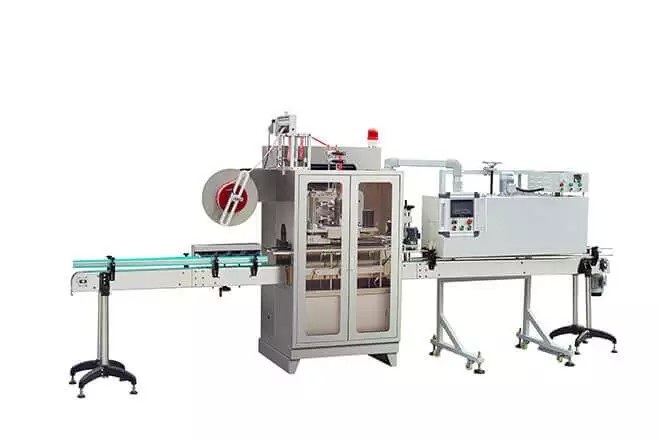
Unlike standard labeling systems, shrink sleeve applicators operating at high throughput must synchronize precision film feeding, accurate cut-to-length registration, seamless sleeve transfer, and uniform heat application all within fractions of a second per container. Achieving this requires more than robust hardware; it demands intelligent motion control, real-time feedback loops, and thermal management engineered for continuous operation.
One hallmark of machines built for speed is their use of rotary or orbital application platforms. These designs eliminate start-stop motion, allowing bottles or cans to move continuously through the labeling zone while sleeves are applied with micron-level accuracy. Paired with high-frequency servo drives and low-inertia mechanical components, such systems can reliably process 400 to 1,000+ containers per minute without sacrificing placement quality.
Thermal stability is another critical aspect. At elevated line speeds, even minor inconsistencies in tunnel temperature or airflow can cause uneven shrinking, leading to wrinkles, misalignment, or film splitting. Advanced shrink sleeve label machines for high-speed lines now incorporate multi-zone infrared or convection tunnels with closed-loop temperature sensors that dynamically adjust based on ambient conditions and container material ensuring consistent results regardless of production tempo.
Equally vital is upstream compatibility. High-speed labeling only works if the entire line flows smoothly. Modern machines feature synchronized infeed starwheels, accumulation buffers, and reject diversion mechanisms that prevent jams from cascading backward into fillers or cappers. Some even integrate with vision systems that detect missing or skewed sleeves before they enter the tunnel, automatically ejecting non-conforming units without halting the line.
Durability under stress also sets true high-speed performers apart. Components like film unwind brakes, cutting blades, and gripper belts are engineered for extended service life under constant load, often using wear-resistant composites or self-lubricating materials to reduce maintenance frequency.
Finally, data visibility matters. Leading systems provide live metrics on cycle rate, film usage, reject count, and energy consumption enabling operators to fine-tune performance and predict maintenance needs before failures occur.
For businesses scaling into national distribution or contract manufacturing, choosing a shrink sleeve label machine capable of sustained high-speed operation isn’t just about volume it’s about reliability, repeatability, and resilience. In environments where every second counts, the right machine doesn’t just keep up it leads the line forward.
Contact: Wendy
Phone: +86-13482266656
E-mail: wendy.jiang@sr-packing.com
Add: No. 18, Changting Road, Fengxian District, Shanghai, China


 Español
 русский
 Português
 Deutsch
 Français
 Italiano
 Nederlands
 Polski