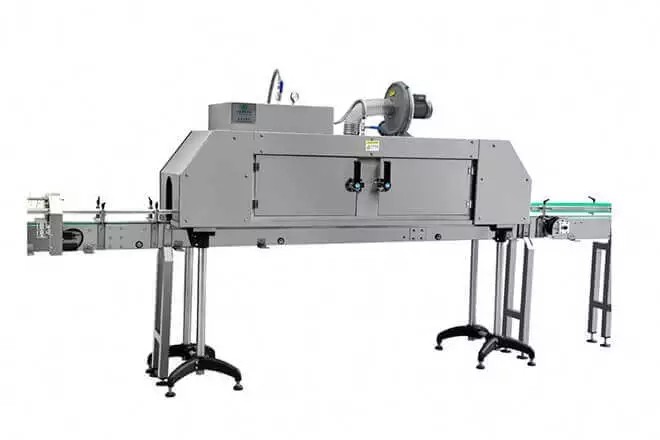
In the high velocity world of beverage and consumer goods packaging, the shrink sleeve labeling process is only as good as its final step: the shrinking phase. While the labeler applies the sleeve, it is the steam heat tunnel that transforms a loose plastic film into a tight, wrinkle free, 360 degree branded surface. As production lines accelerate and sustainability standards rise, steam heat tunnel technology is evolving to meet the dual demands of extreme speed and energy efficiency.
The Superiority of Steam Over Hot Air
For high quality shrink sleeve applications, steam remains the gold standard compared to traditional hot air tunnels. The physics of steam heating offers distinct advantages that are critical for premium packaging:
Uniform Heat Transfer: Steam provides consistent, omnidirectional heat transfer. Unlike hot air, which can create hot spots and cold zones, steam condenses on the bottle surface, releasing latent heat evenly. This ensures the film shrinks uniformly, eliminating unsightly wrinkles or "dog ears" and ensuring perfect registration of the graphics.
Gentle on Heat Sensitive Containers: Steam tunnels operate efficiently at lower temperatures than hot air systems. This is crucial for the growing market of lightweight PET bottles, which can easily deform under the intense heat required by air tunnels. Steam allows for the perfect shrinking of the label without distorting the container itself.
Driving Efficiency in High Speed Production
As bottling lines push beyond 60,000 bottles per hour, the steam heat tunnel must keep pace without consuming excessive energy. Modern engineering is addressing this through advanced airflow management and thermal recovery systems.
New generation tunnels are being designed with segmented heating zones and intelligent steam flow controls. This allows operators to direct heat exactly where it is needed for example, applying more steam to the shoulder of a uniquely shaped bottle while using less on the body. This precision not only improves the quality of the shrink but significantly reduces steam consumption, lowering operational costs.
Integration and Automation
The modern steam heat tunnel is no longer an isolated unit but an integrated part of the smart factory. Connectivity is becoming a standard feature, allowing the tunnel to communicate with the upstream labeler and filler.
Automatic Speed Synchronization: The tunnel automatically adjusts steam pressure and conveyor speed to match the flow of bottles, preventing energy waste during low-volume runs or stoppages.
Quick-Change Capabilities: To accommodate short production runs and diverse SKU portfolios, newer tunnels feature rapid adjustment mechanisms. Operators can switch bottle heights and diameters in minutes without tools, minimizing downtime during changeovers.
Supporting Sustainability Goals
Beyond energy efficiency, steam heat tunnels play a vital role in the industry's shift toward eco-friendly materials. As brands transition from PVC to recyclable PET-G and PLA films, the thermal properties of these materials change. Advanced steam tunnels offer the precise temperature control required to activate these sensitive bio films correctly, ensuring they shrink effectively without burning or clouding.
Contact: Wendy
Phone: +86-13482266656
E-mail: wendy.jiang@sr-packing.com
Add: No. 18, Changting Road, Fengxian District, Shanghai, China


 Español
 русский
 Português
 Deutsch
 Français
 Italiano
 Nederlands
 Polski