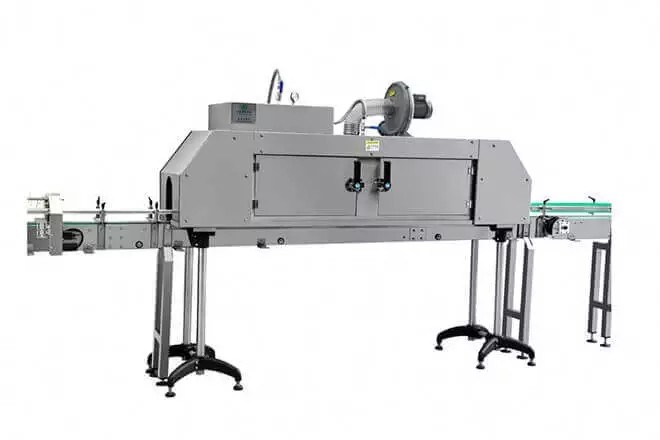
In the high speed environment of modern bottling and packaging lines, the final stage of production often determines the consumer's first impression of product integrity. The shrink band heat tunnel serves as the critical gateway where loose protective films are transformed into tight, tamper evident seals. While the application of the sleeve is a mechanical task, the shrinking process is a complex thermal engineering challenge that demands precise control to ensure security without compromising the structural integrity of lightweight containers.
Advanced Airflow Dynamics and Thermal Zoning
The core functionality of a modern shrink band heat tunnel relies on sophisticated airflow management rather than simple radiant heating. Contemporary systems utilize multi zone convection heating, where independent temperature controls are applied to the top, bottom, and sides of the tunnel chamber. This zoning capability is essential for handling containers with irregular neck finishes or complex cap geometries. By directing high velocity hot air through specialized nozzles, the tunnel ensures uniform heat distribution around the entire circumference of the band. This prevents common defects such as "dog ears" or uneven shrinking, which can occur if one side of the band receives more thermal energy than the other. The result is a pristine, professional finish that signals quality to the end user.
Accommodating Lightweighting Trends in Packaging
As sustainability initiatives drive the industry toward lightweighting, plastic bottles and caps are becoming thinner and more susceptible to heat distortion. A high performance shrink band heat tunnel must navigate the narrow window between activating the shrink film and deforming the container. Advanced tunnels address this by integrating rapid response heating elements and intelligent cooling sections. The heating zone brings the film to its activation temperature quickly, while an immediate downstream cooling chamber stabilizes the band before the residual heat can migrate into the container neck. This thermal isolation allows manufacturers to use thinner, cost effective films and lightweight preforms without risking batch rejection due to warped caps or crushed bottle necks.
Energy Efficiency and Operational Sustainability
Energy consumption has become a primary metric for evaluating packaging line efficiency. Traditional heat tunnels often suffered from significant thermal loss and long warm up times. Newer designs incorporate insulated chamber walls and recirculation systems that capture exhaust heat and redirect it back into the heating cycle. This closed loop approach drastically reduces electricity usage and maintains a stable internal temperature even during brief production pauses. Furthermore, the adoption of variable frequency drives for circulation fans allows the tunnel to adjust airflow volume based on line speed. When the conveyor slows down or stops, the system automatically reduces fan speed and heat output, preventing energy waste and extending the lifespan of heating components.
Contact: Wendy
Phone: +86-13482266656
E-mail: wendy.jiang@sr-packing.com
Add: No. 18, Changting Road, Fengxian District, Shanghai, China


 Español
 русский
 Português
 Deutsch
 Français
 Italiano
 Nederlands
 Polski