In the realm of premium beverage and consumer goods packaging, the visual impact of a container is often the deciding factor in a consumer's purchasing decision. Full body shrink sleeve labels have become the industry standard for creating vibrant, 360 degree branding canvases on complex container geometries. However, the transition from a loose PVC, PETG, or OPS film to a flawless, skin tight finish relies entirely on the thermal processing stage. This is where the steam heat shrink tunnel distinguishes itself as an indispensable asset, offering a level of uniformity and material preservation that conventional hot air systems simply cannot replicate.
The Physics of Uniform Heat Transfer
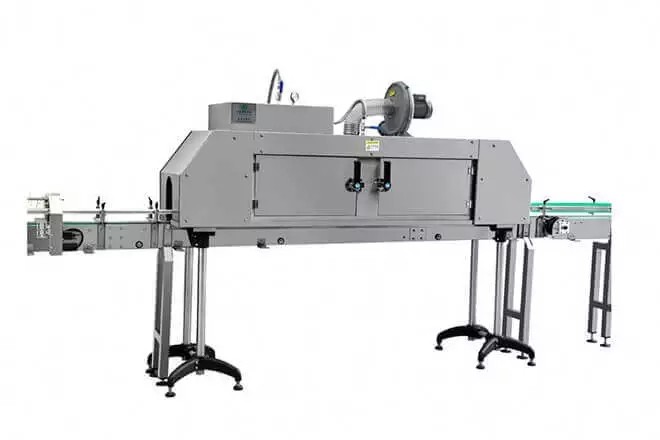
The fundamental advantage of a steam heat shrink tunnel lies in the thermodynamic properties of saturated steam compared to forced hot air. Air is a poor conductor of heat, often resulting in temperature gradients within a tunnel that can cause uneven shrinking, particularly on containers with irregular contours, deep recesses, or varying wall thicknesses. In contrast, steam utilizes latent heat transfer. When saturated steam comes into contact with the cooler surface of the labeled container, it condenses into water, releasing a significant amount of energy instantly and uniformly across the entire surface. This phenomenon ensures that every square millimeter of the shrink film receives the exact same thermal input simultaneously. For manufacturers producing contoured bottles or multi pack bundles, this eliminates the "dog earing" effect and ensures that the label conforms perfectly to intricate neck rings and base curves without leaving unsightly wrinkles or distortion.
Preserving Substrate Integrity and Dimensional Stability
Many modern packaging lines utilize lightweighting strategies to reduce plastic consumption, resulting in PET bottles with extremely thin walls that are highly susceptible to thermal deformation. Hot air tunnels typically operate at temperatures ranging from 150°C to 200°C, which poses a significant risk of distorting the container itself before the film has fully shrunk. A steam heat shrink tunnel operates at a much lower, controlled temperature range, usually between 85°C and 100°C. This gentle thermal environment is sufficient to activate the shrink memory of the film but remains below the glass transition temperature of the PET substrate. Consequently, manufacturers can achieve a high quality 360 degree label application without compromising the structural integrity of the bottle, preventing ovalization or base instability that could lead to jams in downstream filling or palletizing equipment.
Energy Efficiency and Operational Sustainability
As industrial facilities face increasing pressure to reduce their carbon footprint, the energy dynamics of the packaging line come under scrutiny. While the generation of steam requires a boiler, the actual application within the tunnel is remarkably efficient. Modern steam tunnel designs incorporate advanced recirculation systems and precise condensate recovery mechanisms. The steam is injected into a sealed chamber where it is continuously recirculated by high efficiency fans, ensuring minimal waste. Furthermore, because the heat transfer is instantaneous, the exposure time required for the container is significantly reduced compared to convective heating. This allows for shorter tunnel lengths and faster line speeds. The condensate produced during the shrinking process is collected and returned to the boiler system, reducing water consumption and lowering the energy required to preheat fresh feed water. This closed-loop approach aligns with sustainable manufacturing practices by maximizing thermal efficiency and minimizing resource wastage.
Precision Control for Diverse Film Chemistries
The packaging industry is seeing a shift toward eco friendly film substrates, including bio based PLA and thinner gauge PETG, each possessing distinct shrink initiation temperatures and shrink ratios. A sophisticated steam heat shrink tunnel provides the granular control necessary to handle these sensitive materials. By regulating the steam pressure and injection flow rate, operators can maintain the chamber temperature with a precision of ±1°C. This stability is critical when running high speed lines where even a minor temperature fluctuation can result in registration errors or incomplete shrinking. The ability to fine tune the thermal profile allows converters and bottlers to switch between different film types seamlessly, ensuring consistent quality whether applying a standard PVC sleeve or a specialized recyclable mono material film.
Contact: Wendy
Phone: +86-13482266656
E-mail: wendy.jiang@sr-packing.com
Add: No. 18, Changting Road, Fengxian District, Shanghai, China


 Español
 русский
 Português
 Deutsch
 Français
 Italiano
 Nederlands
 Polski